Tent Q&A
Dome Tent vs Cabin Tent: Which Should You Buy?
Heads up: some links below go to Amazon. If you buy through them it costs you nothing extra, and we may earn a small commission that keeps this site running. We only recommend tents we'd actually take camping.
The fastest way to answer "dome tent vs cabin tent" is to picture the two shapes. A dome curves up to a peak, with walls that slope inward the whole way — round, low, aerodynamic. A cabin stands up like a little room, with tall, near-vertical walls and a flat-ish roof. Almost every difference that matters flows from that one shape decision, and once you understand it, the choice gets easy.
We've pitched both kinds across plenty of trips, and the honest summary is that neither is "better" — they're built for different jobs. A dome buys you a lighter, cheaper tent that shrugs off wind. A cabin buys you standing headroom and elbow room, at the cost of weight, money, and a bigger wind profile. Below we break down exactly how they differ, then help you pick by the trip you're actually taking.
Dome vs cabin: the core trade-off
A dome tent is built from two (sometimes three) poles that cross over the top and bend down to the corners, pulling the fabric into that signature curve. That curve is the whole point. Sloped walls shed wind and rain instead of catching them, the flexing poles spring back in a gust, and there's simply less fabric and hardware — so the tent is lighter, packs smaller, costs less, and goes up fast. The price you pay is interior shape: the walls lean in, so usable headroom collapses everywhere except dead center.
A cabin tent flips the priorities. Extra poles and structure hold the walls upright and near-vertical, which turns the floor plan into something close to a real room — you can stand, stretch, set up cots, and walk around the edges without ducking. That comfort costs you. More poles and fabric mean more weight, more money, and a longer pitch. And those tall flat walls behave like a sail: they catch wind that a dome would slip past, so a cabin needs careful staking and guying when the weather turns.
| Dome tent | Cabin tent | |
|---|---|---|
| Wall shape | Sloped, curved inward | Tall, near-vertical |
| Standing room | Center only (bigger sizes) | Yes, across most of the floor |
| Wind | Sheds it well | Catches it — more exposed |
| Weight & packed size | Lighter, smaller | Heavier, bulkier |
| Price | Usually cheaper | Usually pricier |
| Setup | Fast, often solo | Longer, easier with two |
| Best for | Backpacking, wind, solo & couples | Family base camp, long stays |
The case for a dome tent
If we had to hand one tent to a first-time camper without knowing their trip, it'd be a dome. The shape forgives a lot. It's the style that handles weather with the least fuss, weighs the least, and costs the least — which is exactly why the budget market is full of them.
Domes win on
- Wind — sloped walls shed gusts
- Weight and packed size
- Price, especially small/mid sizes
- Fast, often one-person setup
Domes give up
- Standing headroom away from center
- Vertical wall space for cots/gear
- That "real room" feel on long stays
- Easy in-and-out without ducking
The budget dome we reach for first

Coleman Sundome
The classic budget dome — welded bathtub floor, fast pitch, steady in a breeze. Roughly $45–$115.
The Coleman Sundome is the dome we point most people toward because it nails the things a dome is supposed to do. Its WeatherTec system uses a welded bathtub floor with inverted seams, so groundwater has no needle holes to creep through. It rides on fiberglass poles, goes up in about ten minutes, weighs roughly 9.8 lb, and comes in 2-, 3-, 4-, and 6-person sizes. It's steady in a breeze and, like any budget tent, struggles in a real gale — but pitched tight and guyed out, that curved shape does its job. What you won't get is standing room: it's a sit-up, kneel, and sleep tent, which is exactly the dome trade-off. We go deeper in our ranked best cheap tents for camping.
At the absolute bottom of the budget, the Amazon Basics 3-Season Dome (our score 4.4/5, around $42) is the cheapest honest dome we link. It's a simple 2-to-4-person dome with a rainfly and a mesh roof — light, easy, and genuinely fine for fair-weather camping, festivals, or a first tent. Be clear-eyed about it, though: it's a fair-weather shelter, not a pop-up or storm tent. For a dry weekend or a passing shower it's the right tool; for a night of real rain you want more tent.
The case for a cabin tent
Now the other side. The first time you stand up to pull on your pants inside a cabin-style tent instead of doing the horizontal sleeping-bag shuffle, you understand the appeal instantly. Vertical walls turn a tent from a place you sleep into a place you can live — and on a multi-day family trip, that comfort is the whole game.
Cabins win on
- Standing headroom across the floor
- Usable space for cots and gear
- Room dividers and family layouts
- Comfort on long base-camp stays
Cabins give up
- Wind performance — tall walls catch it
- Weight — heavier and bulkier to haul
- Price — more poles, more fabric
- A quick solo setup
The roomy pick that leans cabin-ish
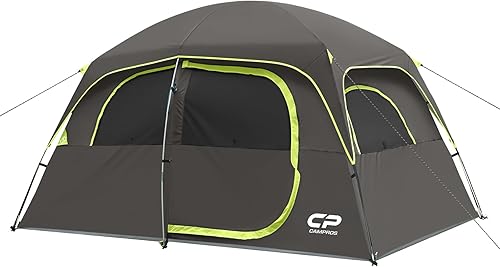
CAMPROS CP 6/8-Person
A roomy family tent with a divided-room layout and traditional poles. Around $110.
If you want the space-and-comfort side of this debate on a budget, the CAMPROS CP 6/8-Person is the one we point families toward. It's a roomy family tent that blurs the dome/cabin line — big enough to walk around in, with a divided-room layout, a rainfly, mesh panels for airflow, and a carry bag. It's described as waterproof and windproof, and it rides on traditional poles — worth flagging because it is not an instant or pop-up tent, so plan on a real (and easier-with-two) pitch. That's the cabin-side trade: more room and more living space, in exchange for more tent to set up and haul. For more options in this lane, see our best family tent under $150 guide.
The wild card: ultralight, in a class of its own
One more shape worth naming, because people lump it in with domes. A backpacking tent like the Naturehike Cloud-Up 2 (our score 4.5/5, around $119) isn't really competing with cabins at all — it's a different sport.

Naturehike Cloud-Up 2
A 2-person double-wall backpacking tent at roughly 3.3 lb on the trail. Around $119.
This is a 2-person ultralight double-wall tent in 20D nylon on aluminum poles, with an included footprint, a real PU3000–4000mm coating, and taped seams. It packs down to roughly 3.3 lb trail weight (about 4 lb packed), which is in a totally different universe from a 9.8 lb car-camping dome, let alone a family cabin. The catch: it's snug, and short for tall sleepers. If your "dome vs cabin" question is really "what do I carry on my back," this is the answer — and if you're weighing it against a car-camping dome, our Cloud-Up 2 vs Coleman Sundome comparison lays it out.
So which should you buy?
Forget the labels for a second and answer one question: what's the trip? That decides it almost every time.
Buy a dome if…
- You're carrying the tent any distance — backpacking, bike-packing, or a long walk from the car. Weight and pack size rule here, and that points ultralight (Cloud-Up) or to a light dome.
- Wind is in the forecast, or you camp somewhere exposed — ridgelines, beaches, open plains. The curved shape is the safer bet.
- You're solo or a couple, mostly using the tent to sleep, and you want the most tent for the least money. A Sundome or the Amazon Basics dome covers it.
- You want a fast, do-it-yourself pitch after a long day.
Buy a cabin-style tent if…
- You're car camping at a base camp and the tent stays put for days — you'll trade pack size for living space happily.
- You want to stand up to dress, run cots or air mattresses, and not crawl over each other. Vertical walls are the only way to get that.
- You're a family or group that values a divided interior and room to spread out. The CAMPROS is built for this.
- The weather you expect is mild to moderate, and you're willing to stake and guy carefully if a breeze kicks up.
The honest middle ground: most budget family campers are best served by a big, roomy tent that leans cabin-ish — enough standing room to be comfortable, without paying for a true expedition shelter. And anyone who hikes to camp should default to a dome or ultralight tent and never look back. The trouble only starts when people buy a tall cabin tent for a windy, packed-in trip — that's the mismatch we see most.
The bottom line
Dome tents trade standing room for being lighter, cheaper, and calmer in wind — the right call for backpacking, exposed sites, and solo or couple trips. Cabin-style tents trade weight, money, and wind resistance for headroom and living space — the right call for a family base camp you'll actually spend time in. Pick the shape that matches your trip, not the one with the bigger spec sheet. If you only camp occasionally and want one safe default, a quality dome like the Coleman Sundome is the easiest tent to be happy with.
Check the Sundome price on Amazon →FAQ
Is a dome tent or a cabin tent better in wind?
A dome tent. Its sloped, curved walls shed wind instead of catching it, and the crossed-pole frame flexes and springs back. A cabin tent's tall, near-vertical walls act like a sail — roomier in calm weather, but they catch far more wind, so they need careful staking and guying when a breeze picks up. Both budget styles are steady in a breeze and struggle in a real gale; the dome simply has more margin.
Can you stand up in a dome tent?
Usually only in the center, and only in larger sizes. A dome's walls slope inward toward a single high point, so headroom drops fast as you move toward the edges. Smaller domes are sit-up-and-kneel tents. If standing up to change clothes matters to you, that's the main reason to step up to a cabin-style tent with near-vertical walls.
Are cabin tents harder to set up than dome tents?
Generally yes, by a little. A classic two-pole dome is one of the simplest tents to pitch — cross the poles, clip, done. Cabin-style tents have more poles and more structure to hold those vertical walls upright, so they take longer and are easier with two people. They're not difficult, just bigger jobs. And note a traditional-pole cabin tent is not the same as an instant or pop-up tent.
Which is cheaper, a dome or a cabin tent?
Dome tents are typically cheaper, especially in small and mid sizes, because they use fewer poles and less fabric — a simple 2-to-4-person dome can run around $40. Cabin-style family tents cost more thanks to the extra material and structure, while big roomy domes that lean cabin-ish sit in the middle. Match the spend to the trip rather than chasing the lowest sticker price.