Home › Budget Roundups › Best Tents Under $30
Best Tents Under $30: What You Actually Get (and What to Buy Instead)
Heads up: some links below go to Amazon. If you buy through them it costs you nothing extra, and we may earn a small commission that keeps this site running. We only recommend tents we'd actually take camping.
Let me save you a disappointing weekend. If you typed "best tents under $30" into a search bar, you're hoping for a real, dry, sleep-in-it tent for less than the price of two pizzas. I wish I could hand you one. The honest truth, after years of pitching budget gear in real weather, is that a genuine sub-$30 tent is almost always a disposable thing — a festival pop-up, a beach sun-shade, or a kids' play tent — not a shelter you'd want over your head when the sky opens up.
That doesn't mean you walked into the wrong store. It means the smart move is to know exactly what $30 buys, when it's the right call, and where the real value floor sits — which, spoiler, is about ten to fifteen bucks higher than you'd guess. I'll show you both, with no sermon attached.
What "under $30" actually buys you
Price isn't magic. A tent costs what it costs because of materials and construction, and at the very bottom of the market something has to give. Below $30, the cuts land in the places you can't see in a product photo. Here's what's really in the box.
It's usually not a camping tent at all
The honest sub-$30 shelves are dominated by three things: festival pop-ups (the kind that spring open and barely survive one muddy weekend), beach and sun shelters (open on one side, never meant for rain), and kids' play tents (adorable, indoor-grade, not waterproof). They photograph like "real" tents. They aren't built like them. None of that is a scam — it's just a different product wearing the same word.
The poles are the first thing to go
Cheap tents lean on thin fiberglass wands, and fiberglass has a nasty failure mode: it doesn't bend and recover, it splinters. One gust catches a saggy pop-up, a pole shatters, and now a jagged shard is poking through the sleeve and out the side of your tent. I've watched it happen at a festival campsite at 2 a.m. — there's no field fix for a splintered fiberglass pole except duct tape and regret.
The floor and seams are where the water gets in
The single biggest tell of a disposable tent is the floor. A throwaway tent uses a thin sewn-in sheet with a needle hole at every stitch, and the "rainfly" (if there is one) is partial or barely water-resistant. Pitch it in a drizzle and you'll likely be fine. Pitch it under a night of steady rain and water wicks up through the floor seams and in around a fly that doesn't reach far enough down. If you want the full mechanics of why this happens — and the cheap fixes — we wrote a whole piece on whether cheap tents leak and how to stop it.
When a sub-$30 tent is genuinely the right call
I'm not here to talk you out of cheap. Sometimes disposable is exactly the correct tool, and pretending otherwise is just snobbery. A $25 pop-up is a smart buy when:
- It's a one-and-done festival — three dry days, you don't care if it survives, and you might literally leave it behind. (Please don't, but you know the campsite reality.)
- It's a backyard or living-room tent for the kids — no weather, no stakes, all fun.
- It's a beach day-shelter — shade and a windbreak, never a place you sleep through rain.
- You truly only camp once a year, in summer, and never in rain — and you've made peace with replacing it.
In all of those, spending more is the mistake. The trouble starts when people buy a $25 festival tent expecting it to be their actual camping tent for the next five years. That's the round trip that ends with you buying twice.
The smarter floor: spend around $40–45 once
Here's the value case, plainly. The jump from roughly $30 to about $42 is the best ten dollars you'll spend on a tent. It's the line where you cross out of disposable and into "a tent you keep." You don't need to leap to $100 — you need to clear the disposable threshold. Two tents do that, at two different price points.
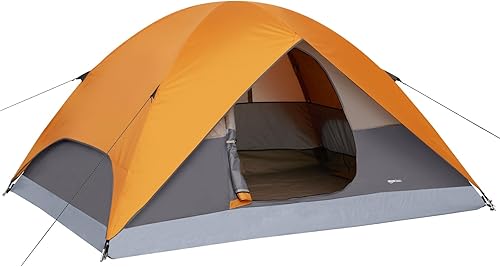
Amazon Basics 3-Season Dome
Around $42 · Our score: 4.4/5 · The cheapest tent here I'd actually call a tent.
If you want the cheapest honest shelter, this is it. The Amazon Basics 3-season dome usually runs around $42 — call it ten or twelve dollars over your $30 target — and that small step changes the category. It's a no-frills 2-to-4-person dome with an actual rainfly, a mesh roof for airflow, simple pole setup, and a build that survives more than one trip. It is not a pop-up and it is not a storm tent: think fair-weather camping, festivals, the backyard, or a beginner's first real tent. But it'll come back season after season instead of going in the bin Monday morning, and that's the whole difference between $25 and $42. For the money, nothing under $30 competes with it.
What's good
- Real rainfly + mesh roof, not a partial festival cover
- Light and simple to pitch — genuine beginner-friendly
- Survives repeated trips; not a one-weekend throwaway
- About the lowest price for a tent worth keeping
Know before you buy
- Fair-weather shelter — not built for a night of real rain
- Basic sewn floor, so seam-seal it before a wet trip
- No frills: no vestibule, no fancy weather system
- Snug if you actually pack in 4 adults

Coleman Sundome (2-Person)
Around $45 for the 2P · Our score: 4.6/5 · The one I trust in actual rain.
If there's any chance you'll meet weather, spend the extra few dollars on the Coleman Sundome. The 2-person starts around $45 (the bigger sizes climb from there), and what you're buying is Coleman's WeatherTec system: a welded, seamless bathtub floor with no needle holes for groundwater to creep through, plus inverted wall seams and a partial fly. That welded floor is the exact part a sub-$30 tent skips, and it's why this thing has gotten me through multi-hour rain with the only "leak" being water off my own jacket. It's heavier (around 9.8 lb) and takes about ten minutes with fiberglass poles — this is a car-camping tent, not a backpacking one — but for a tent that genuinely holds up, $45 is a steal. With tens of thousands of strong Amazon ratings, it's the closest thing to a default answer in budget camping.
Sub-$30 vs. the smart floor, side by side
Same camper, same rainy night, two very different mornings. This is the trade in one table.
| Typical "under $30" tent | Amazon Basics dome (~$42) | Coleman Sundome (~$45) | |
|---|---|---|---|
| What it really is | Festival pop-up / beach / kids tent | No-frills 3-season dome | Proven budget car-camping dome |
| Poles | Thin fiberglass, splinter-prone | Standard fiberglass, decent | Fiberglass — steadier in real wind |
| Floor | Thin sewn sheet, needle holes | Basic sewn floor | Welded, seamless bathtub floor |
| Rain | Light drizzle only | Showers, not storms | Holds real rain when pitched tight |
| Lifespan | Often one trip | Many seasons | Many seasons |
| Our score | — | 4.4/5 | 4.6/5 |
The column on the left isn't worthless — it's just narrow. It does one job (a dry weekend in fair weather) and then it's done. The two on the right do that job and survive to do it again, for about the cost of a couple of coffees more. If you only ever buy one tent, buy from the right two columns.
How to shop the under-$30 shelf without getting burned
If you're set on staying under $30 — budget's budget, I get it — here's how to pick the least-bad option and use it well.
- Read the listing for the word "festival," "beach," "pop-up," or "play." Those are your honesty flags. A tent that calls itself a beach shelter isn't lying to you; treat it accordingly.
- Check the floor description. If there's no mention of a bathtub floor or a waterproof rating, assume the floor is the weak point and bring a groundsheet.
- Look at the pole material. Fiberglass at this price is a given; just know it's brittle and don't force a bent pole.
- Ignore the photo's blue sky. Every listing shows a sunny meadow. Plan for the rain it'll actually meet, then decide if this tent can handle it. (Often the answer is "for an hour.")
- Be honest about how often you'll camp. If the answer is "more than once," you've already justified the jump to $42.
The bottom line
There's no great "best tent under $30" because true sub-$30 tents are disposable by design — fine for a dry festival or a kid's backyard fort, shaky the moment real rain or wind shows up. The genuinely smart budget move is to clear the disposable line: around $42 gets you the Amazon Basics dome, a real tent you'll keep, and about $45 gets you a Coleman Sundome with a welded floor that handles actual rain. Spend the extra ten dollars once. It's cheaper than buying twice.
Check the Amazon Basics dome price →Ready to shop the tier that's actually worth your money? Our best cheap tents under $50 roundup ranks every pick that clears the disposable line, and our main shortlist of the best cheap tents sorts the dry ones from the damp ones across every budget.
FAQ
Are there any good tents under $30?
Genuinely good ones are rare. At under $30 you're almost always looking at disposable festival pop-ups, beach/sun shelters, or kids' play tents. They'll keep dew and a light drizzle off you for a weekend, but most use flimsy fiberglass wands, thin un-taped seams, and a floor that isn't built for real groundwater. They're fine as a one-trip throwaway and a bad bet as your actual tent.
Why do sub-$30 tents leak so easily?
Two reasons: construction and coverage. The floor is usually a thin sewn-in sheet with needle holes at every seam, and the rainfly is partial or barely water-resistant. Add a saggy pitch from skinny poles and water finds the low spots. In a passing shower you'll be okay; in a night of steady rain you'll wake up damp.
Is it worth spending $40 instead of $30 on a tent?
Usually yes. The jump from roughly $30 to $40–45 is the single best value step in budget tents. Around $42 the Amazon Basics 3-season dome gives you a real rainfly and a tent that survives more than one trip; around $45 the Coleman Sundome adds a welded bathtub floor that actually holds back groundwater. That extra ten or fifteen dollars buys you a tent you keep, instead of one you replace.
What's the cheapest tent that isn't disposable?
The Amazon Basics 3-season dome, usually around $42, is the realistic floor for a tent you'll actually reuse. It's a no-frills 2–4 person dome with a rainfly and mesh roof — fair-weather and festival duty, not a storm tent, but built well enough to come back season after season instead of going in the bin after one weekend.