Best Cheap Tent for Boy Scouts: Durable, Simple, Affordable
Heads up: some links below go to Amazon. If you buy through them it costs you nothing extra, and we may earn a small commission that keeps this site running. We only recommend tents we'd actually take camping.
A scout tent has a harder job than most. It gets pitched in the dark by an eleven-year-old, stuffed back in the bag wet, dragged across a gravel site, and left to soak through a surprise thunderstorm — and it has to do all that without costing more than the rest of the kit combined. So the "best" tent for a Boy Scout isn't the toughest or the lightest or the cheapest on its own. It's the one that's simple enough for a kid to pitch, durable enough to survive rough handling, weatherproof enough to keep a troop dry, and cheap enough that a dinged-up tent isn't a tragedy.
We've pitched every budget tent on this site in real weather, and we keep coming back to two answers for scouts: the Coleman Sundome as the all-around default, and the Amazon Basics 3-season dome as the rock-bottom-price pick for fair-weather campouts. Below we'll explain exactly what a scout tent needs, name the two we'd hand a troop, cover the one ultralight option for scouts who hike in, and be honest about how to make a budget tent last.
What a Boy Scout tent actually needs
Before the picks, it helps to be clear about what matters here — because a scout tent is judged on different things than a backpacker's or a family camper's tent. Four traits do the heavy lifting.
1. Simple setup a kid can manage
This is the big one. A scout often pitches their own tent, sometimes in fading light with a patrol leader hollering about dinner. That rules out anything fiddly. You want a basic dome with two poles that cross, ideally color-coded, that goes up in minutes without a manual. Avoid "instant" or pop-up designs that look easy but fight you when a pole sticks — and avoid sprawling cabin tents with a dozen poles. The simpler the geometry, the faster a kid gets it right.
2. Durability for rough handling
Scout gear lives hard. Poles get forced, zippers get yanked, the tent gets dragged and stuffed wet. Fiberglass poles are forgiving here — they flex instead of snapping, and replacement sections are cheap. A welded or "bathtub" floor (where the floor fabric curves up the sides with no seam at ground level) survives abrasion and groundwater far better than a flat, stitched floor. You're not buying an heirloom; you're buying something that takes a beating and keeps working.
3. Weather protection
Campouts happen rain or shine, and a wet scout is a miserable scout. You want a real rainfly and a floor that resists groundwater. Budget tents don't publish wind ratings, so judge them honestly: a well-staked dome is steady in a breeze and struggles in a real gale — which is true of nearly every tent in this price range. The fix is a good pitch, not a bigger number. As a rough guide on fabric, a rainfly rated around 1,500mm hydrostatic head is solid for sustained rain, though most budget brands simply don't print the figure.
4. Low cost
Scout tents get destroyed eventually — it's the nature of the activity. Spending $300 on a tent a kid will outgrow or shred in two seasons makes no sense. The sweet spot is a tent good enough to trust in weather but cheap enough that you're not heartbroken when it retires. Everything we recommend below lands there.
Our top pick: Coleman Sundome

Coleman Sundome
Simple 10-minute setup, welded weatherproof floor, and tough enough for troop abuse — at a budget price.
If we could hand a troop just one tent, it'd be the Coleman Sundome. It nails all four scout requirements at once, which almost nothing else at this price does. Setup is about 10 minutes with two crossing poles — straightforward enough that a kid can learn it in one backyard practice run and own it from then on.
What makes it our pick for durability and weather is Coleman's WeatherTec system: a welded bathtub floor with the seams heat-sealed shut so there are no needle holes for groundwater to creep through, plus inverted wall seams to keep water out and a partial rainfly over the mesh roof. The poles are fiberglass, so they flex under the kind of rough handling a scout dishes out instead of snapping. At roughly 9.8 pounds it's no backpacking tent, but for car-camping and troop campouts that weight is a non-issue. It comes in 2, 3, 4, and 6-person sizes, so you can match it to how your troop pairs up.
Why scouts love it
- Genuinely simple 10-minute, two-pole setup
- Welded bathtub floor resists groundwater and abrasion
- Fiberglass poles flex instead of snapping
- Sizes from 2P to 6P to match your pairing
- Trusted name at a budget price
Keep in mind
- Partial fly — pitch tight in sideways rain
- ~9.8 lb, so it's car-camping, not backpacking
- Still a budget tent — treat it gently to last
It's not flawless. The fly is partial rather than full-coverage, so in wind-driven rain you'll want it staked drum-tight with gear kept off the walls. And like any budget tent, it rewards care — but as an all-rounder a scout can pitch alone and trust in weather, nothing else at this price touches it. We go deeper on the floor and seams in our look at whether you need a footprint for a Coleman tent.
The budget pick: Amazon Basics 3-Season Dome
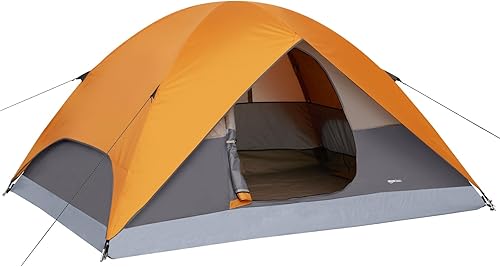
Amazon Basics 3-Season Dome
The lowest-price honest shelter — simple, light, and fine for fair-weather troop campouts.
When price is the deciding factor — buying for a whole patrol, or a brand-new scout who might lose interest — the Amazon Basics 3-season dome is the cheapest shelter we'll honestly recommend, usually around $42. It's a simple 2-to-4-person dome with a rainfly and a mesh roof for airflow, and it's light and easy to pack. The setup is the same beginner-friendly two-pole dome design as the Sundome, so a kid can manage it just as easily.
Be clear-eyed about what it is, though: it's a basic 3-season dome, not a pop-up and not a storm tent. It's a great match for dry-weather weekends, summer camp, festivals, and the backyard — the fair-weather majority of troop campouts. But it doesn't have the Sundome's welded WeatherTec floor, so in a night of real, sustained rain it needs a careful pitch and a footprint more than the Coleman does. For most fair-weather scouting it's all the tent you need, and buying the honest match is cheaper than buying twice.
| Coleman Sundome | Amazon Basics Dome | |
|---|---|---|
| Our score | 4.6 / 5 | 4.4 / 5 |
| Best for | All-around, any weather | Fair-weather, lowest price |
| Setup | ~10 min, two poles | Simple two-pole dome |
| Floor | Welded WeatherTec bathtub | Standard sewn floor |
| Weather | Handles real rain (pitched tight) | Showers, not storms |
| Sizes | 2 / 3 / 4 / 6P | 2–4P |
| Rough price | $45–115 | ~$42 |
For the scout who hikes in: Naturehike Cloud-Up 2
Most scouting is car-camping or a short walk from the trailhead, and for that the dome tents above are exactly right — no need to spend more. But some older scouts get into real backpacking, where every ounce on their back matters and a 9.8-pound dome is a non-starter. That's the one case where we'd point them somewhere else.

Naturehike Cloud-Up 2
A 2-person ultralight double-wall tent for the scout who's carrying it up the trail.
The Naturehike Cloud-Up 2 is a 2-person ultralight double-wall tent built from 20D nylon, with aluminum poles, a PU3000-4000mm coating, and taped seams — meaning it has a genuine, published waterproof rating, which the budget domes don't. A footprint is included, and it packs down to around 3.3 pounds on the trail (roughly 4 pounds packed with everything). For a scout hauling their own shelter over miles, that weight difference is the whole game.
The catch is that it's a snug, fairly short tent — taller scouts will find it tight, and it's a backpacking shelter, not a roomy basecamp. At around $119 it also costs more than the domes. So this is a deliberate, narrow pick: reach for it only if the scout is genuinely going lightweight and carrying the tent on their back. For everyone else, the Sundome or Amazon Basics dome is the smarter buy.
Treat a budget tent gently (and use a footprint)
Here's the honest part most roundups skip. Budget tents earn their price by trimming the things you can't see in a photo — thinner poles, lighter zippers, simpler floors. They hold up fine, but they reward care, and a scout tent that's babied a little lasts seasons longer than one that's abused. A few habits make all the difference:
- Use a footprint. A footprint or a cut piece of cheap groundsheet under the tent takes the abrasion of rocks and roots instead of the floor. Keep it tucked just inside the floor edge so it doesn't catch runoff and funnel water underneath. This is the single best thing you can do for a scout tent's lifespan.
- Don't force the poles. Fiberglass flexes, but it splinters if jammed. Teach your scout to feed poles through gently and ease them into the grommets.
- Stake it and guy it out. A taut pitch sheds wind and rain; a saggy one flaps, pools water, and wears out fast. Use the guy lines.
- Never pack it away wet. A tent stuffed damp grows mildew that rots the coating and reeks. Dry it fully at home — drape it over a fence if you struck camp wet.
- Practice once at home. A single backyard pitch turns a stressful first campout into a routine your scout already owns.
The bottom line
For most scouts, the Coleman Sundome is the best cheap tent there is: simple enough for a kid to pitch in 10 minutes, durable enough for rough handling thanks to its welded floor and flexible fiberglass poles, weatherproof enough to keep a troop dry, and cheap enough that wear-and-tear isn't a tragedy. If your campouts are dry-weather and price rules, the Amazon Basics dome is the honest budget pick. And if your scout is hiking in with the tent on their back, the ultralight Cloud-Up 2 is the exception worth paying for. Whatever you pick — add a footprint and practice once in the backyard.
Check the Sundome price on Amazon →Want the full shortlist with prices? Our best cheap tents under $50 roundup covers the rock-bottom options, and our ranked picks of the best cheap tents sort the trustworthy ones from the ones to skip.
FAQ
What is the best cheap tent for a Boy Scout?
For most scouts, the Coleman Sundome is the best balance of simple, durable, weatherproof, and cheap. It sets up in about 10 minutes with poles a kid can manage, its welded WeatherTec bathtub floor resists groundwater, and it holds up to rough handling. If you want the absolute lowest price for fair-weather troop campouts, the Amazon Basics 3-season dome is a fine, simpler shelter.
How big a tent does a scout need?
Most troops have scouts tent in pairs, so a 2 or 3-person tent is the usual size. We actually suggest sizing up one person from the headcount — a 3-person tent for two scouts plus their packs is far more comfortable and keeps gear off the walls. The Coleman Sundome comes in 2, 3, 4, and 6-person versions, so you can match it to how your troop pairs up.
Can a kid set up a budget tent themselves?
Yes, with a simple dome tent and one practice run in the backyard. Both the Coleman Sundome and the Amazon Basics dome use a basic two-pole crossing design with no instant or pop-up mechanism to fight. Have your scout pitch it once at home before the first campout so the troop isn't waiting on them in the dark.
Do budget scout tents need a footprint?
We strongly recommend one. A footprint or a cut piece of cheap groundsheet under the tent protects the floor from the abrasion of rocks, roots, and dragged gear — exactly the rough handling a scout tent takes. Keep it tucked just inside the floor edge so it doesn't catch runoff and funnel water underneath you.
Is a Coleman Sundome durable enough for scouts?
For the price, yes. The fiberglass poles flex rather than snap, the welded bathtub floor has no needle holes to fail, and the design is forgiving of an imperfect pitch. It's still a budget tent, so it lasts longest when treated gently: stake it properly, don't force the poles, keep it off sharp gravel with a footprint, and dry it fully before storage.