Tent Q&A
Are Coleman Tents Good? An Honest Take After Years of Budget Camping
Heads up: some links below go to Amazon. If you buy through them it costs you nothing extra, and we may earn a small commission that keeps this site running. We only recommend tents we'd actually take camping.
Short answer: yes, Coleman tents are good — for the money, for the trips most people actually take. I've handed a Coleman to more nervous first-time campers than any other brand, and they keep coming back happy. But "good" needs an asterisk, because Coleman is good at one specific job and bad at another, and the internet loves to argue about it without saying which one they mean.
We've pitched basically every budget tent on this site in real weather, including a stack of Colemans across a lot of soggy weekends. So instead of a vague thumbs-up, here's the honest version: where Coleman genuinely shines, the three real caveats (weight, fiberglass poles, a partial fly), and the one type of camping where I'd tell you to skip Coleman entirely and buy something else.
Where Coleman is genuinely good
Coleman has been making tents since before "ultralight" was a marketing word, and that experience shows up in the boring stuff that actually keeps you dry. The headline feature is WeatherTec, and it's not just a sticker on the bag.
WeatherTec is the real reason I trust them in rain
WeatherTec is Coleman's weatherproofing package, and the part that matters most is the welded, seamless bathtub floor. Most cheap tents sew the floor to the walls, and every one of those stitches is a needle hole groundwater can creep through. Coleman heat-welds the floor seams shut instead — no holes, no wicking. Add inverted wall seams (so the stitching faces inward, away from the rain) and taped fly seams, and you've got a budget tent that genuinely resists water out of the box.
In the field that holds up. I've sat out multi-hour rain in a Coleman where the only "leak" turned out to be water dripping off my own jacket. Coleman pegs the WeatherTec setup at meaningfully more water resistance than comparable tents, and the frames hold steady in the kind of wind most campsites see, which is more than most car campers will ever see. If you want the deep dive, we wrote a full breakdown of whether the Coleman Sundome is waterproof.
The value is hard to argue with
A Coleman Sundome runs somewhere around $45 to $115 depending on size and where you catch it — check the current price, because it swings with sales. For that you get a tent that survives years of weekend abuse, sets up in about ten minutes solo, and comes in 2, 3, 4, and 6-person sizes. There's a reason it sits near the top of our ranked best cheap tents list: very few tents under $100 give you this much proven durability.

Coleman Sundome
The budget tent I hand nervous first-timers — welded WeatherTec floor, ~10-min setup, around $45–115.
The Coleman Sundome is the tent I point to when someone asks "is Coleman good?" because it's the brand at its most honest: not fancy, just dependable. It weighs about 9.8 lb, which we'll come back to, but for hauling it from the trunk to a campsite that weight is invisible — and it buys you a floor and frame that take a beating.
The three real caveats
Here's where I get to be the guide who tells you the truth before you're standing in the rain wishing someone had. None of these are dealbreakers for car camping. All of them are worth knowing before you buy.
What Coleman nails
- Welded, seamless WeatherTec floor
- Genuinely durable over many seasons
- Fast, beginner-friendly setup (~10 min)
- Strong value at around $45–115
- Sizes from 2 up to 6 people
What to know first
- Heavy — ~9.8 lb, car camping only
- Fiberglass poles, not aluminum
- Partial fly leaves lower walls bare
- Not for backpacking or the trail
- Bulky packed size in the trunk
1. They're heavy
A Sundome is around 9.8 lb. That's thick fabric, a heavy-duty floor, and the poles, all chosen for durability rather than grams. For car camping that weight is a feature — it's part of why the thing lasts. The only time it matters is if you're carrying it anywhere on your back, which brings us to the section at the end. Driving to the site? You'll never notice.
2. Fiberglass poles, not aluminum
This is the caveat I'd actually flag hardest. Coleman's budget domes use fiberglass poles, and fiberglass is heavier, less springy, and more prone to splintering or cracking in hard wind or real cold than aluminum is. For normal 3-season car camping they hold up for years — I've got Colemans with poles that have outlasted entire other tents. But if you regularly camp in storms, or you want poles that flex instead of snap, aluminum is the upgrade worth paying for. (Spoiler: the backpacking pick at the bottom has aluminum poles.)
3. The dome models use a partial rainfly
Most Coleman domes, the Sundome included, ship with a partial fly that covers the mesh roof but leaves the lower walls exposed. In still, vertical rain that's totally fine. In wind-driven, sideways rain, water can hit the bare wall fabric, and if your gear is leaning against that wall, it can wick through. It's not the fabric failing — it's coverage. The fix is free: pitch it drum-tight, use the guy lines, and keep gear off the walls. Know this going in and it's a non-issue. Get surprised by it at 2 a.m. and you'll blame the tent unfairly.
Where Coleman shines vs. where it doesn't
The whole "are Coleman tents good" debate falls apart the second you split it by use case. Same tent, opposite verdict depending on how you camp.
| Use case | Coleman verdict | Why |
|---|---|---|
| Car camping | Excellent | Weight is irrelevant, durability and WeatherTec shine |
| Family weekends | Excellent | Roomy sizes, fast setup, survives kids and years |
| Festivals / fair weather | Good | Cheap, tough, easy — though you can go cheaper still |
| Storm / heavy weather | Decent | Welded floor is great; fiberglass poles + partial fly are the limit |
| Backpacking / ultralight | Skip it | Too heavy and bulky for the trail — buy a trail tent |
If your camping looks like "drive somewhere pretty, set up near the car, sleep, repeat," Coleman is close to the best money you can spend. If your camping involves a trailhead and a pack, keep reading — because this is the one place I'd steer you away from Coleman entirely.
The one place Coleman doesn't belong: the trail
Coleman makes car-camping tents. Full stop. Trying to backpack with a 9.8 lb Sundome is how you end up hating camping. The fabric is too heavy, the fiberglass poles add bulk, and the packed size eats your pack. None of that is a Coleman flaw — it's just the wrong tool. You wouldn't haul a cast-iron skillet up a mountain either.
For the trail you want something built around grams: a double-wall tent in the 3–4 lb range with aluminum poles. My budget pick there is the Naturehike Cloud-Up 2.

Naturehike Cloud-Up 2
Budget ultralight, ~3.3 lb trail weight, 20D nylon, aluminum poles, footprint included.
The Cloud-Up 2 is a different animal: a 2-person, double-wall tent that drops to roughly 3.3 lb trail weight (about 4 lb packed), with 20D nylon, springy aluminum poles, a footprint thrown in, taped seams, and a serious PU3000–4000mm waterproof rating. It runs around $119 — check the current price. It's snug for two adults, so I'd call it a roomy solo or a cozy two, but for actually carrying your shelter it's in a league the Sundome was never trying to enter. If you mostly drive to camp but take the occasional overnight hike, owning both isn't overkill — they do genuinely different jobs.
What about a bigger family Coleman alternative?
One more honest note, since people ask. If you've got a big family or you want two "rooms," Coleman makes larger cabin-style tents, but they get pricey fast and you start running into the same fiberglass-and-weight trade-offs at scale. A budget alternative I like for roomy family setups is the CAMPROS CP 6/8-Person.
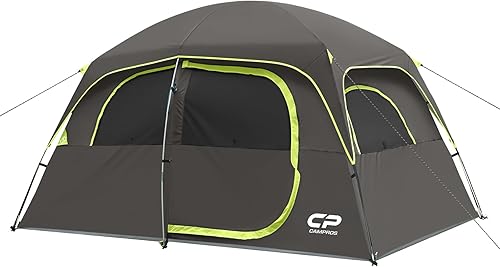
CAMPROS CP 6/8-Person
Big dome/cabin with a rainfly, mesh windows, and a divided-room option — traditional pole setup, around $110.
The CAMPROS is a roomy family dome/cabin with a full rainfly, mesh windows for airflow, and a divider so you can split it into two rooms — handy with kids. It uses a traditional pole setup (you thread the poles yourself, no instant-pitch gimmicks) and packs into a carry bag, running around $110. It's not built around Coleman's welded WeatherTec floor, so the usual seam-seal-and-pitch-tight discipline matters more, but for square footage per dollar it's a strong call. If you're weighing it against Coleman's own bigger tents, this is the price-first option.
The bottom line
Are Coleman tents good? Yes — for car camping, they're one of the best values in budget gear, thanks to a welded WeatherTec floor and years-long durability. Just go in knowing the three caveats: they're heavy, the poles are fiberglass, and most domes use a partial fly. For driving to a site and sleeping dry, the Coleman Sundome is my default recommendation. For the trail, skip it and grab a real ultralight tent instead.
Check the Sundome price on Amazon →Still deciding? Our ranked picks of the best cheap tents put Coleman next to the alternatives, and the budget tent buying guide walks through poles, fly coverage, and mm ratings so you can match the tent to your trips, not someone else's.
FAQ
Are Coleman tents actually good quality?
For the price, yes. Coleman tents are well-built car-camping shelters with welded WeatherTec floors, taped fly seams, and sturdy frames that hold up in normal weather. The trade-offs are weight and fiberglass poles instead of aluminum, plus a partial rainfly on the dome models. They're not premium backpacking gear, but as a $45–115 family tent that survives years of weekend use, the quality is genuinely good.
Why are Coleman tents so heavy?
Because they're built for car camping, not your back. A Coleman Sundome runs roughly 9–10 lb thanks to thicker fabric, a heavier floor, and fiberglass poles. That weight buys durability and weather resistance you carry from the trunk to the site, so it's a non-issue for car campers and a dealbreaker for backpackers — who should look at an ultralight tent like the Naturehike Cloud-Up 2 instead.
Are Coleman fiberglass poles a problem?
They're the main thing I'd flag. Fiberglass poles are heavier, less springy, and can splinter or crack in hard wind or cold, where aluminum would just flex. For normal 3-season car camping they hold up fine for years. If you regularly camp in storms or want poles that take a beating, an aluminum-pole tent is worth the upgrade.
Is a Coleman tent good for backpacking?
No. Coleman dome tents are too heavy and bulky for the trail at around 9–10 lb. They're designed to be driven to a campsite. For backpacking you want something in the 3–4 lb range with aluminum poles, like the Naturehike Cloud-Up 2, which packs down to roughly 3.3 lb on the trail.
Is the Coleman Sundome waterproof?
Mostly, yes. The Sundome's WeatherTec system uses a welded, seamless bathtub floor and inverted wall seams, so groundwater has no needle holes to creep through. The catch is the partial rainfly, which leaves the lower walls exposed to wind-driven rain. Pitch it tight, guy it out, and keep gear off the walls and it shrugs off normal storms — there's more in our Sundome waterproof breakdown.